Santiago

Greetings from my second Santiago of the trip, Santiago de Chile. After Ancud I caught a bus to Puerto Montt, and then from there took a (quite comfortable) 12 hour overnight bus ride to Santiago. I’ve been here almost a week, hanging out with my friend Andy, who came down from Seattle to link up for some vacation. At this point I am well and truly not in the small cities and towns of the south anymore – Santiago is a city of around 5 million people, and sprawl is an appropriate descriptor. It’s also, unfortunately, the most polluted city I’ve ever seen – there’s a thick layer of brown all around on the horizon, sometimes so bad that you can’t even see the mountains which surround the city and make the smog so bad. On the other hand, there are lots of parks and green spaces, one of my favorite features that a city can have.

Andy and I have spent lots of time just walking around taking in the city. A lot of areas are sort of nondescript, filled with big square buildings, small shop fronts, bars, etc…, but we have also strolled through some beautiful leafy residential areas, hip artsy neighborhoods, and even in the less interesting areas turning a corner can suddenly reveal a small side street with adorable older houses painted every possible color. On our first day we accidentally stumbled onto Cerro Santa Lucia, a park/hill in the center of town with lots of little paths and greenery, topped by a sort of castle thing, with great views of town. On a different day we also climbed Cerro San Cristobal (in the incredible heat), the highest point in the city, where you can see the apartment buildings stretching off into the distance.

We went to a few museums – to be honest the Museum of Fine Arts and the Museum of Contemporary Art were a bit disappointing (in my ever so humble opinion), but the small, out of the way Museo Ralli was great. Its eclectic collection of modern and contemporary art was organized in an interesting way, highlighting both Chilean/South American art and also the museum’s collection of Rene Magritte lithographs and Salvador Dali statues. The museum itself is nestled in a posh neighborhood a ways out from the center, which gave us an interesting change of scenery on the long walk out. Another attraction we visited was La Chascona, Pablo Neruda’s house which he built (and named) for his third wife. It’s quite a complex, and the poet’s imagination and taste certainly shine through. Lastly, earlier today we went to the Museo a Cielo Abierto (Open Air Museum) in the San Miguel neighborhood. If you click on the link you can read a full history and look at the murals, but to briefly summarize, this is a project that was started in 2009 to revitalize and highlight a low income neighborhood by covering the huge housing buildings with murals. At this point there are at least 40 murals, many of which deal with issues important to the community like Chilean heritage or workers’ rights. The murals are huge, most are brightly colored, and all have lots of detail, making for a delightful afternoon strolling around looking.

We’ve also been eating pretty well. The food culture here is interesting. There’s a fair amount of fairly unappetizing food, exemplified by the staple completo, a hot dog usually covered in avocado, tomato, and an astonishing amount of mayonnaise. Don’t get me wrong, it’s delicious at the right time, but it’s not necessarily the tastiest representative food I’ve ever come across. There are tons of medium quality sushi restaurants, and lots of little places selling cheap daily menus, usually fried fish or grilled meat with potatoes and a drink. Seafood is the prize jewel, and we’ve been largely sticking to that. Lots of every type of shellfish, tons of salmon, and various other fish. The other day I had a piece of grouper that may have been the best fish I’ve ever eaten. So that was nice. The other notable food in Santiago is ice cream – they love ice cream here. You can hardly walk two blocks without seeing an ice cream shop, and for a few hours in the early afternoon when the sun is especially hot you can hardly walk two blocks without crossing someone with an ice cream cone in their hand. It’s a cultural practice that I support.

That’s about all I’ve got. I’ve really enjoyed my time here but I think 6 days is enough. I had originally been thinking about settling down in Santiago for a month or two but I think the sprawl and pollution are a bit too much for me, so I’ll be looking to find somewhere else to volunteer teaching or something like that. Tomorrow I’m up (relatively) early to get myself cleaned up and off to the airport, where 13 hours of travel separate me from New York’s ugly weather. I’ll be spending about a week and a half there, visiting Liv and recharging, and then I’ve got a return flight to Santiago March 1st. After that I’m not exactly sure what I’ll be doing – I think I’d like to head north and check out the Atacama desert, and then maybe continue to Peru or Bolivia and settle down to volunteer for a bit. I’ve got some research to do on that point but I’ll update as soon as I know anything more!

Goodbye Patagonia

I’m sitting here in an adorable, trendy café in Ancud, a city at the northern tip of the island of Chiloe, looking up the territorial limit of Patagonia. There’s no actual definition but it seems that I’m currently right about there: Wikipedia tells me the northern limit of Chilean Patagonia is usually agreed to be the Reloncavi Estuary, which is about level with where I am. The map on Wikipedia doesn’t include Chiloe as part of Patagonia but let’s just fudge that and say that I’m still in Patagonia; today is my last day.

After Puyuhuapi I kept heading north, hitchhiking up to another little town called La Junta, then straight west to a very small, fairly isolated port town called Raul Marin Balmaceda. The drive out to Raul Marin Balmaceda runs along a river through a few farms and mostly untouched, densely green hills. It’s gorgeous. In Raul Marin I spent a couple of days relaxing, strolling along the many kilometers of sandy beach, and watching black and white dolphins play around right next to the pier. It was quiet and relaxing, and good to disconnect; the town only has one restaurant that has wifi, so I was left with my own largely mundane thoughts. Thinking is exhausting. From Raul Marin I caught a ferry across the water and up to Quellon, the southernmost city on the island of Chiloe. The ride was about 9 hours with one stop, in the small island fishing town of Melinka, which I absolutely adored the sight of. The view as the ferry pulls up is a jumble of brightly colored houses staggered up the hill that rises away from the port, old fishing boats bobbing in the harbor in the foreground. Looking around there is only water and the untouched islands that make up the rest of the archipelago. I’m not sure what the town itself is like but it makes for an absolutely stunning postcard.

Now I’ve spent the past few days here in Chiloe, and it’s been a downright metropolitan experience after the small towns I’ve come from. A quick search online tells me the population of Quellon is a little more than 20,000, and Castro and Ancud both have a little more than 40,000 inhabitants. Absolutely gigantic compared to where I’ve been. I unfortunately haven’t had time to explore and get to the national parks here since I’m working my way up to Santiago fairly quickly but I’ve strolled around and enjoyed the change of scenery. Colorful houses seem to be a theme out here, with all different shades of bright yellows, greens, pinks, blues, and more all thrown together. There is a beautiful yellow church with purple accents dominating the central square in Castro. Gardening also seems like a common activity – most houses have beautiful collections of rose bushes, bright orange flowers, gardenias, and lots of others. I’ve been stopped in my tracks on the sidewalk by the overpowering smell of roses more than once – absurdly corny but true. My understanding is that Chiloe is getting to be well known for its gastronomy and for sustainable practices related to it. I don’t know much about all that, but I know it’s an island so seafood is the way to go. Yesterday, in particular, I ate extraordinarily well. For lunch I went to Mar y Canela, a trendy little restaurant in a Palafito (old wooden houses built on stilts in the bay) in Castro. I had a dozen fresh oysters to start, and then an absolutely delicious piece of fish in a pesto and tomato sauce, topped with perfectly cooked octopus, and then with a plate of clams and crazy giant dinosaur mussels on the side, and a mini spinach omelet. It was a ton of food, and I surely suffered, but don’t worry people – I powered through and enjoyed every bite. Then, for dinner here in Ancud, I had a great local stout to drink alongside a delicious piece of trout in a hollandaise type sauce, with asparagus and corn on the side. Rough life…

So now, after a couple of good coffees and a salad, I’m going to stroll around here a little bit and then catch a bus up to Puerto Montt, where I’ll sit around, hopefully watch some soccer, grab some dinner, and then head to the bus station at 10pm to get on my overnight bus to Santiago. There are a few different classes of busses here in Chile so I plunked down the extra $4-5 for the one where the chairs are soft, wide, and lie almost all the way down, essentially converting into an actual bed. So I’m hoping for a good night’s sleep and to wake up refreshed and ready to go in Santiago tomorrow.

I’ve had a really good time down here in Patagonia. The landscapes and hiking are as spectacular as advertised, the people are friendly, and the towns are adorable. I’ve gotten to see all kinds of birds, foxes, dolphins, guanacos, and an impressive population of stray dogs with surprisingly clean and luscious fur. The food was fairly unimpressive for a while but there were a few delicious stews mixed in there and the recent seafood binge has been delightful. My usual unfriendly demeanor has kept me from making many friends but I have made a few, and I’ve had some nice casual conversations along the way as well. I’ve also gotten a wonderful dose of adorable grandma time – most of the lodging in the small towns is just rooms in people’s houses, and those people are usually adorable grandmas, so I’ve had some nice chats and been taken care of along the way. Just like anywhere there have been tradeoffs and I’ve had to miss out on tons of things I would have liked to do and places I would have liked to go, but I’ve gotten around and seen some great sights. I’d love to come back sometime to see more of the Argentinean side, go whale watching, hike more, and see what else the region has to offer. A change of pace now will be good though – I’m excited to get to the big city and see what Santiago has to offer, and then to take a travel break in New York with Liv for a little more than a week. I’ve been thinking about what I want to do after that when I return to Santiago and have decided it’s time to do some volunteering. There are tons of farms and hostels that want people to work there, which I might try, but ideally I’d like to do something that’s helping a little more. Teaching is the obvious thing that comes to mind, so I’ll be looking into that, but I’ve also seen some volunteer programs at wildlife centers that seem like they would be very cool. We’ll see what I find!

Little Chile

The title of this post comes from the town of Chile Chico, where I crossed from Argentina into Chile and started heading north. It also works because for the past week I’ve just been making my way from one very small town to another. Clever! Anyway, I’m really enjoying it! I’m feeling much better, with just a little bit of a lingering cough, so that helps a lot. As obnoxious as it is for a tourist to complain about a place being too touristy, that’s a little bit of how I was feeling in El Calafate and El Chalten. Here, on the other hand, the tiny towns have a fair few signs for “hospedaje”s and “cabanas” but they feel just a little bit less garish, more rustic, cuter. You see fewer roving packs of backpackers. There aren’t as many excursion and tourism agencies. So there’s a little bit less to do, but it’s all just adorable, and nestled amongst some breathtaking scenery, and I’m finding that I like that just a tad more (plus, again, really can’t overstate the positive effect of feeling better).

From Chile Chico I took a bus around Lago General Carrerra to the truly tiny town of Puerto Tranquilo, which is notable because it’s the access point to the marble caves. These are beautiful rock formations that have been carved over time by the lake, forming tunnels, grottos, and other beautiful shapes. The texture of the rock is really interesting – I would have thought that it would be worn smooth, but instead it has a texture like tiny waves. No idea why that is…. Continuing north from Puerto Tranquilo can be a little bit complicated since there’s no way to reserve a bus. You have to just show up in the morning and hope that a bus passes through with a spot for you, which is no kind of guarantee, as the guys I met who had to spend an extra night can attest to. I got lucky though; the first bus arrived to a swarm of backpackers hoping to get on, to which the driver said that there were no spots at all. He went to the little café and had his coffee and sandwich, relaxed, etc…, and the crowd dispersed. After 20 minutes or so he came back ready to head out again, and it just so happened that we were still standing around next to the bus, because, hell, we didn’t have anywhere else to go. When he was loading up again I asked if there was room (for three no less!) and he said yes, so my new friends and I were off. From there I went to Coyhaique, which is something of a regional hub. I was a little embarrassed at how much I enjoyed being somewhere that resembles a miniscule city as opposed to just a tiny town – actual grocery store, real pharmacy, things like that. It wasn’t that I had some important shopping to do but more just a change of scenery. And it’s really a very cute miniscule city – surrounded by mountains, still very small and quiet, with a beautiful central square. From Coyhaique I hopped a bus to the tiny town of Puerto Cisnes, and from there to my current tiny town, Puyuhuapi, which is known for its hot springs and its proximity to Queulat National Park.

I’ve really enjoyed the last few bus rides. The scenery changed very gradually but at some point I realized that it had truly transformed from the windswept plains and severe, towering peaks further south to a deep, lush greenery covering smoother, rounder mountains. The density of vegetation is fairly astonishing considering how far south I still am, but a wizened old Chilean man was telling me just this evening that the area apparently gets an average of 3.5 meters of rain per year, so that might explain it. The sides of the road are overgrown with this remarkable plant whose stalk is apparently similar to rhubarb (or maybe it just is rhubarb) and which grows as just one single gigantic leaf – the biggest ones I’ve seen must have been 3.5 or 4 feet wide. It’s a truly impressive picture to see dozens of them all growing together, covering up the base of a cliff right next to the road.

Today I went down to the hot springs, 6 kilometers south of town. I took the only bus available (a minivan) at 9:30 so I got there around 10 and there was not a soul around. I was expecting natural hot springs but it’s actually a set of pools set into a wooden boardwalk. The background is fantastic though, right next to an ocean channel, with deep green mountains rising up on the island on the other side. I spent a little less than two hours boiling in the pool, with a quick dip in the cold ocean in between, and then had a nice relaxing walk back to town. Tomorrow I’m on the road again – I’m going to try my luck hitchhiking, heading north to a place called La Junta before hopefully turning west and catching a ride out to what is apparently another very very small port town called Raul Marin Balmaceda. There isn’t much traffic along this road so fingers crossed. After that the plan is to hopefully catch a ferry to Quellon, on the island of Chiloe, and then head north through the island (with some tasty seafood along the way) to Puerto Montt. From there, depending on timing, I might check out Puerto Varas, a stone’s throw away, or just head straight to Santiago. There are a few other places I’d like to check out between Puerto Montt and Santiago (notably Pucon, which looks unreal, dominated by one of Chile’s most active volcanoes) but I’m not sure I’ll have time so I might just have to leave that for later. We’ll see what happens!

The Argentinean Side

Leaving Argentina for a while (and a week since my last post) makes now a good time for an update. I’m currently hanging out in my hostel in El Chalten, waiting for the overnight bus that will leave me in Los Antiguos tomorrow morning. From there I’ll walk or hitchhike across the border to Chile Chico. After that I’m not exactly sure – Chile Chico is apparently a cute, tranquil town, and somewhere close are the marble caves, which look spectacular. I’ll be trying to make my way there and then just working my way north along the famous carretera austral, which is supposed to have tremendous scenery most of the way, hitchhiking or taking buses as I go.

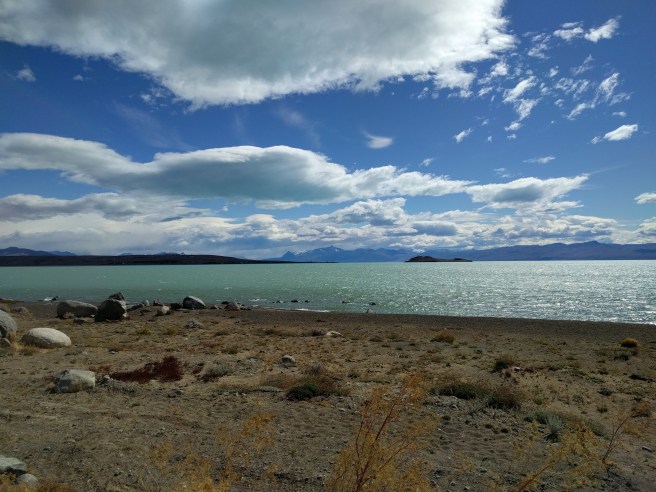
This past week I’ve been in two towns in Argentina, El Calafate and El Chalten. They’re close to each other, and each sits next to a gigantic lake. I first spent two nights in El Calafate, which is a little bigger than El Chalten but still a small town. It has one main street with restaurants and bars, a nice walk along the lake (although the wind can be murder), and is mostly known for being the place from which to go see the Perito Moreno glacier, one of the most beautiful glaciers around. Unfortunately, through bad scheduling and general stupidity, I spent my day and a half there walking around the lake, checking out the town, and fighting with ATMs (more on that later), and did not, in fact, make it out to see the glacier. So that was pretty dumb, but I’ve looked at pictures, and hey, you can’t win ’em all. From El Calafate I caught a bus a few hours up to El Chalten, which is a tiny town nestled in the shadow of the famous Mt Fitzroy. The main attraction here is hiking – there are several good day hikes and a few camping opportunities right around here, and they all end up with various views of the dramatic mountains right outside of town.

IMG_20160223_151612
Lago Argentino, next to El Calafate

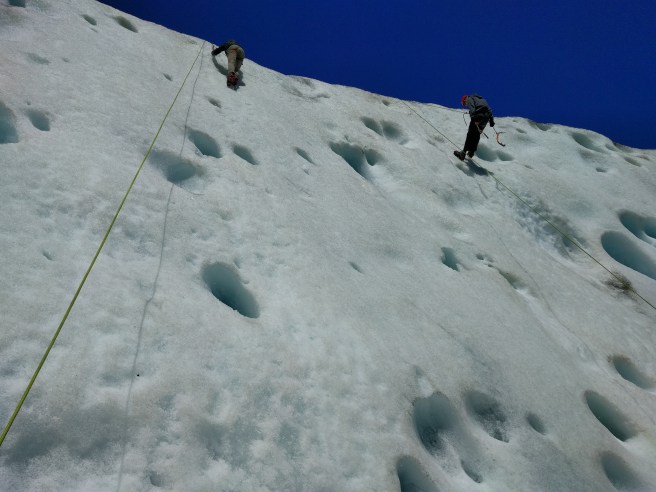
My first day I took it easy and went for one of the shorter, flatter hikes. It was ok but the weather ended up cloudy and drizzly so when I got to the end you couldn’t see the mountains at all, which was a bummer. The next day, on the advice of some friends I met in Ushuaia, I went ice climbing (!), which was fantastic. We took a boat across Lake Viedma to the Viedma glacier, where the first task was learning to walk with crampons. I’m no crampon expert but these were serious, murderous crampons, and it took a little getting used to, although after a while I felt pretty comfortable with them – they sure do give you grip on ice. After that we went to a kiddie wall and busted out the axes for our first lesson, before progressing to bigger and bigger walls. I had been a little bit afraid that we weren’t going to get to climb much since the refund policy (which was the first thing they talked to me about after I paid…) stated that they considered the activity complete if we did a single climb, but my misgivings turned out to be unfounded. The weather was gorgeous all day and we ended up getting in 2 or 3 climbs on each of 4 walls. I was more than satisfied, and really exhausted by the end. That night I was very, very tired and felt a little strange – I couldn’t decide if it was sunburn, dehydration, getting sick, or a little of everything.

IMG_20160226_132806IMG_20160226_145823

IMG_20160226_205319
Dinner treat after a long day of climbing ice

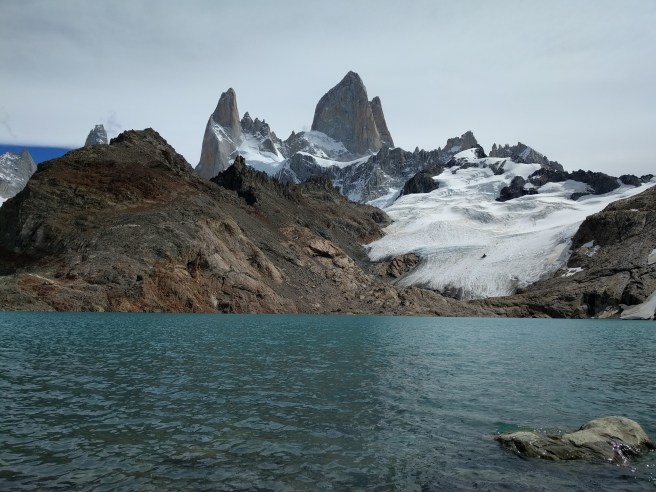
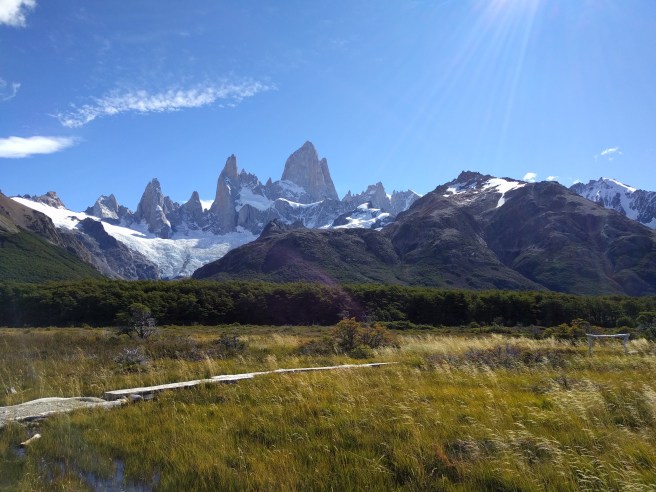
The next day I hiked to the Laguna de Los Tres, which sits right up against Mt Fitzroy. It was a little cloudy in the morning and I was afraid it was going to be like my first hike, but by the afternoon the clouds were gone and I was treated to some really spectacular views. On the way back I was, again, extremely tired, and by the time I got back to the hostel I was totally exhausted and had a bit of a cough. So I think I caught something here in El Chalten, and I spent yesterday and today just sitting around the hostel resting. Yesterday I was still feeling very tired and headachey but today I feel a bit better, so hopefully that continues in spite of my overnight bus ride tonight. Either way I’ll be getting plenty of rest going forward and I’m sure I’ll be feeling better soon. So not to worry my dear, loving family – I proooobably will not die of some mutant super combination of Zika, Chikungunya, and Malaria. But seriously, I will be keeping a close eye on it and I’ll get myself checked out if things get worse. I’m pretty sure it’s just a quick flu though and I’ll be feeling normal in a few days.

IMG_20160227_121703
So the sign says there are mountains there…
IMG_20160227_142415
There are mountains there!
IMG_20160227_161315
Sunshine and mountains even!

My feelings about Patagonia thus far are mixed. On the one hand I’ve always been fascinated by the area and the landscapes truly are dramatic and beautiful. There are tons of outdoor activities (lots that I didn’t even try – 4 wheeling, kayaking, horseback riding) and the hiking is top notch. So for all of that it has really lived up to my expectations. What, in retrospect, I obviously should have realized beforehand is that an area this remote will also have its tradeoffs. Many of the towns don’t have a whole lot going on. Decent fruits and vegetables can be hard to get ahold of, and the food has been largely unremarkable, with the exception of some king crab in Ushuaia. There’s sort of a closed loop of tourism that goes Ushuaia – Torres del Paine – El Calafate – El Chalten, so you end up seeing a lot of the same people, or at least a lot of the same type of people, and it wasn’t really the type that I tend to connect with, so I mostly spent time by myself. And good lord, getting money in Argentina. Some of you may be familiar with the blue dollar, the alternative exchange rate that existed while the Argentinean government was artificially inflating the value of its currency. The new president (elected, I believe, only a month or two before I arrived) got rid of that and let the currency float, so the trick isn’t finding people to change money anymore, and going to ATMs isn’t a complete robbery. But it’s still really bad! The fees are some of the highest I’ve seen, about 6 bucks per transaction, but the transaction limit is the real crime – many ATMs only let you withdraw less than 70 dollars per transaction. So that’s a 10% fee, and it gets worse! It’s not at all uncommon for ATMs to simply be out of money, especially on weekends, so you end up hunting around town for one that still has money. And then, one particular network of ATMs has a bizarre problem – asking for too much money gets you a reply that you’re exceeding your limit, but then asking for an appropriate amount of money, one chosen from the options on the screen, gets you a message that you’ve entered an invalid amount. It’s not a huge deal but it’s an annoyance I hadn’t even thought about, and given that a lot of places in Argentina don’t take credit cards it’s enough to drive you insane.

Overall I’d have to say my quibbles are mostly small things adding up, and I’m very happy that I made it down here to see the end of the world, to backpack around for 8 days, and to see the wonderful landscapes. I’m ready to push on to a change of scenery but I wouldn’t hesitate to come back.

That’s about it for now! I’ll check back in soon, hopefully with some beautiful pictures of marble caves!

P.S. I’m posting this late because the entire town of El Chalten has internet on a satellite link, making it the slowest internet I have ever used. I could intermittently send messages on WhatsApp but loading webpages was out of the question. So I’m posting from Chile Chico and missing my deadline, but in my heart I’m still a winner.